
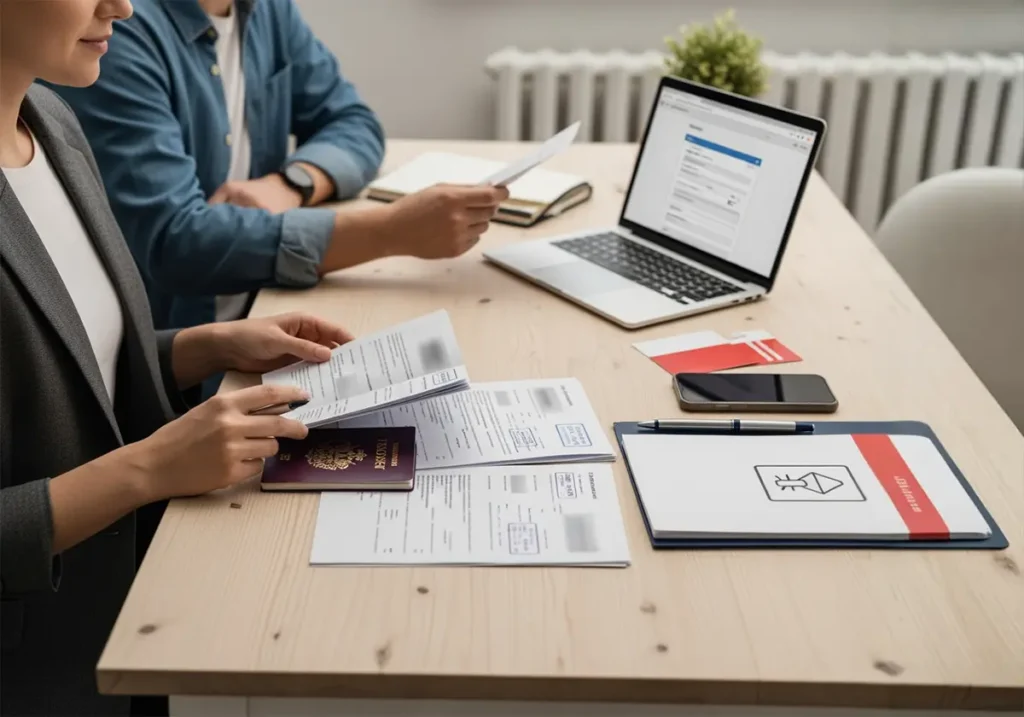
If you’re moving to Poland from outside the European Union, the biggest mistake is thinking that “documents” are just a checklist you can complete after arrival. In reality, several key steps – especially apostille or legalisation, and certified (sworn) translations in Poland – can be slow, expensive, or hard to fix once you’re already here.
This guide explains the most common documents you should prepare before coming to Poland, why they matter in practice, and how to avoid delays later. It’s written for non-EU foreigners moving to Poland in 2026 and focuses on practical readiness, not legal theory.
Important: This article is general information, not legal advice. Requirements can differ depending on your nationality, your reason for stay (work, studies, family, business), and even the local office handling your case. When something affects your legal status, always verify it in official sources or with a qualified advisor.
Note: Paperwork is just one side of the coin. If you want to know what to expect from daily life, safety, and cultural norms, read our guide: Moving to Poland: Expat Life and Expectations.
What changes in 2026: more online procedures (MOS + praca.gov.pl)
In 2026, many processes that foreigners depend on are increasingly digital. You will often hear about two systems early on:
Poland uses the MOS (Moduł Obsługi Spraw) system to handle many residence-related applications and communication with offices. Separately, if you’re coming to work, employers commonly file key steps through praca.gov.pl. This shift is helpful – but only if your documents are ready in the right format (clear scans, consistent data, correct translations, and required authentication).
That’s why “document prep” is not just paperwork. It’s your way to reduce stress, avoid unnecessary trips to offices, and prevent the classic situation where one missing stamp or translation blocks everything.
Before you pick a pathway: build your “Core Document Pack”
Even if you’re not 100% sure whether you’ll come for work, studies, or family reasons, there is a base set of documents that almost always helps. Think of it as your core documents for Poland – the things that are hardest to solve once you’re already here.
You should prepare high-quality scans (PDF), plus originals and a few paper copies, of your passport, key civil status documents (such as a birth certificate, and marriage/divorce documents if relevant), and any papers that will later prove your education, qualifications, and financial stability. In the next sections, I’ll break this down clearly by scenario – work in Poland, studying in Poland, family reunification, business, and moving to Poland with a child – so you can focus only on what applies to you.
The Core Document Pack: what to prepare before you arrive
Before you think about work, studies, or family reunification, build one clean set of documents that you can reuse across most procedures. This is the fastest way to avoid delays later, because Polish institutions often ask for the same foundations in different contexts. Your goal is simple: have documents that are (1) authentic, (2) readable, (3) consistent, and (4) ready to submit.
Start with your passport. Check the expiry date, make sure the passport is not damaged, and keep clear scans of the main page and any visas or entry stamps you already have. Then prepare your core civil status documents – especially a birth certificate, and, if relevant, a marriage certificate or divorce certificate. These papers matter more than many people expect, because they are used to confirm identity details across systems: names, parents’ names, dates, and civil status.
Next, prepare your education and work background documents. If your pathway involves work or regulated professions, you will often need diplomas, certificates, or other proof of qualifications. For studies, you may need school-leaving documents and proof that your education is recognised. Even when a document is not strictly required for entry, having it ready can prevent a “dead end” later.
Finally, prepare documents that show you can support yourself. Many procedures involve some form of proof of funds: bank statements, proof of income, or other credible evidence that you can realistically cover costs. This is also useful for renting a flat or setting up life in Poland during the first weeks.
Your two biggest “hidden blockers”: apostille/legalisation and sworn translation
Two issues create most document problems for non-EU newcomers.
The first is authenticity. Depending on where a document was issued, it may need apostille or legalisation before a Polish institution accepts it. If you arrive without it and later discover you need it, you may be forced into long-distance bureaucracy with your home country.
The second is translation. In many real-life situations, Poland expects a certified (sworn) translation – and in practice, institutions often prefer translations made by a sworn translator in Poland. This is one of the most common reasons why people lose time: they translate documents abroad, and later learn the translation is not accepted for the procedure they are in.
To protect yourself, prepare clean PDF scans and keep originals safe. If you’re unsure whether a document needs apostille or a sworn translation, treat it as a risk item and plan for it early.
Pathway 1: Working in Poland (2026) – documents that usually matter most
If you are coming to work, you will deal with two separate layers: the employer-side employment step and your residence/legal stay step. Even when much of the process is digital in 2026, it is still document-heavy. The difference is that paperwork is uploaded rather than carried around – but missing attachments can still block your case.
Employer-side documents: work permit or employer declaration
In many cases, your employer handles the first formal step through praca.gov.pl. The most common outcomes are a work permit or an employer declaration (Oświadczenie o powierzeniu pracy), depending on your situation. From your perspective, the practical point is: you should have your identity and qualification documents ready so your employer can file accurately and quickly, and so your job description and data match what you later submit in residence procedures.
Residence + work in one procedure: the “single permit” pathway
If you plan to stay longer and work in Poland, a common route is applying for a combined residence and work permit, often described as a temporary residence and work permit (sometimes called a “single permit”). In 2026, this is typically submitted in Poland through MOS (Moduł Obsługi Spraw).
Here is the most important part many newcomers learn too late: the application itself is not the hard part. The hard part is having a complete, consistent document set. Offices may request clarifications or additional attachments, and response deadlines can be strict.
The key attachment: “Appendix No. 1” (Załącznik nr 1)
If you are applying for a residence-and-work type permit, one document is often treated as “critical”: Załącznik nr 1 (Appendix No. 1), completed and signed by your employer. In practice, this paper is where your job details become official: your position, salary, working time, and employer declarations. If this attachment is missing, incomplete, or inconsistent with your contract, your case can slow down quickly.
What you should do before arrival: make sure your employer understands they may need to provide and sign Załącznik nr 1, and make sure the information in it matches your contract and your actual job conditions.
Your employment contract: clarity and language
Your employment contract (or other written agreement) should be prepared carefully. It should exist in written form, and you should receive a version you understand. This is not just comfort – it’s practical. If the contract is unclear or you cannot explain what you signed, you can get stuck later when you need to show consistency between your employment and your residence basis.
Qualifications: diplomas, certificates, and translations
For many jobs, especially where skills are important or regulated, you may need documents confirming qualifications: diplomas, certificates, proof of training, or reference letters. Very often, these require a sworn translation. If you wait until you arrive, you may lose time during the most stressful period – when you also need housing, banking, and daily stability.
A quick reality check: what usually causes delays in work-related cases
Problems rarely come from one “wrong document.” They usually come from small inconsistencies, such as different spelling of names, mismatched dates, missing signatures, or unclear scans. Another common issue is assuming that once the employer has “filed something,” you are automatically covered for every next step. In Poland, employer filings and residence procedures are connected – but they are not the same thing. Treat them as two tracks that must stay consistent.
Pathway 2: Studying in Poland (2026) – education proof, NAWA, and funds
If you come to Poland for studies, your biggest document risk is not the acceptance letter itself. It’s proving that your previous education is valid and recognised, and that you can realistically support yourself during the stay. In 2026, universities and related procedures may be stricter about document quality, authenticity, and recognition.
You should prepare an official acceptance letter for studies in Poland issued by the university. If your program is paid, keep proof of tuition payment in a clear form (receipt, confirmation, bank transfer proof). These documents are usually straightforward.
The part that often takes time is proving your prior education. Depending on your country and document type, you may need a NAWA recognition statement (or other formal confirmation that your school certificate or diploma is recognised in Poland). This is where many students lose weeks because they discover the requirement too late or don’t have properly authenticated originals.
Language is another frequent checkpoint. Many programs expect proof of language ability – for example a B2 language certificate for the language of instruction. Even if your university accepts internal testing, having an external document ready can reduce uncertainty.
Finally, you should prepare proof of funds for studying in Poland. In practice, institutions may expect recent bank statements showing you can cover living costs and also have funds for a return trip. Even when exact amounts vary, what matters is that your financial picture looks realistic and consistent.
Pathway 3: Family reunification / marriage – civil status, stability, and housing
Family pathways are usually document-heavy because the purpose is to prove facts: who you are, what the relationship is, and whether living together in Poland is realistic. The core of this pathway is always your civil status documents.
Prepare certified copies (and scans) of the relevant documents such as a marriage certificate or birth certificate. These documents often need apostille or legalisation, and very often a sworn translation in Poland. If your civil status documents are not properly authenticated or translated, you can hit a hard stop later.
You will also need proof that the family member you are joining has legal status in Poland. That usually means copies of their visa or residence card (Karta Pobytu) and basic identity data.
In real-life procedures, two practical items are checked again and again: stability and housing. That’s why you should prepare documents that show stable income (for example an employment contract or other reliable proof) and a legal title to accommodation in Poland (rental agreement or ownership proof). Even when the exact requirements vary, these documents help demonstrate that the family can live in Poland without falling into administrative “dead ends.”
Pathway 4: Business route – what non-EU founders should prepare
For non-EU foreigners, starting a business in Poland can be possible, but the exact options depend strongly on your current legal status. Many newcomers assume they can simply register a sole proprietorship, and later discover restrictions. In practice, one of the most common structures people use is a limited liability company, often referred to as Sp. z o.o.
From a document perspective, the core set is about proving that the company exists and operates legally. You should prepare the company formation documents, the registration confirmation (for example an entry in the relevant register, depending on the route), and documents that explain what the business does. In many “business stay” narratives, a simple but credible business plan for Poland helps because it shows that the activity is real and economically meaningful, not just a formality.
If the company is already operating, additional papers may appear later – such as proof of tax compliance or basic accounting confirmations. Even if you’re not at that stage yet, planning for clean documentation early makes future steps easier.
The main risk here is misunderstanding: business topics are often mixed with residence questions, and the rules can differ depending on your status. That’s why, in a business pathway, you should treat official verification as mandatory whenever a decision affects your legal stay.
Pathway 5: Moving to Poland with a child – travel, consent, and school documents
If you arrive with a child, your document pack must cover three areas: identity, parental authority, and education.
Start with the basics: the child’s passport is essential, and you should also prepare the child’s birth certificate with a sworn translation if needed. These documents are commonly required in school enrollment, healthcare registration, and administrative steps.
A frequent travel complication happens when a child travels with only one parent. In some situations, border controls, airlines, or institutions may ask for written consent from the other parent. To avoid last-minute stress, prepare a notarised consent letter from the second parent (if applicable), and plan for translation if needed. Even if it is not checked every time, it is the kind of document that is extremely hard to produce quickly once you are already abroad.
If your child will continue education in Poland, prepare school documents such as certificates, reports, and proof of the current education level. Schools and offices may interpret foreign documents differently, so clarity and completeness help.
Pathway 6: “Arrive first, then look for a job” – what you should have ready
Some people come first and search for work on the ground. This can work logistically, but it becomes risky when people confuse “being allowed to enter” with “being allowed to work.” From a document standpoint, your priority is proving that your stay is realistic, organised, and financially covered.
Prepare a valid passport, plus documentation that supports your entry and short-term stay: health insurance that covers your first period in Poland, a confirmed accommodation booking (hotel, rental, temporary housing), and clear proof of funds showing you can support yourself without working immediately.
You should also prepare a strong, ready-to-send CV for Poland in English, and ideally a Polish version if your target roles require it. If you have diplomas or certificates that match your job field, keep them scanned and ready because employers may ask quickly.
A key practical note for this pathway is consistency. If you tell one institution you are a tourist but immediately try to solve matters that imply long-term residence, you may create confusion. Even when you are doing everything legally, mismatched “purpose narratives” can slow you down later. That’s why document readiness and clarity matter so much in this route.
Dealing with administration is often the most stressful part of the “landing” phase. Knowing the myths vs. reality of expat life can help you stay calm while waiting for your permits.
Short summary
If you prepare the right documents to come to Poland before you travel, you avoid the most common delays that happen after arrival. The real “game changers” are not fancy forms – they are the basics done well: your passport, clean scans, essential civil status documents, and (when needed) apostille/legalisation plus a sworn translation in Poland. Once you have a solid core pack, the rest becomes much easier: you simply add the pathway-specific documents for work in Poland, studying in Poland, family reunification, business, or moving to Poland with a child.
FAQ: Documents you should prepare before coming to Poland
What are the most important documents to prepare before coming to Poland?
Start with a valid passport, your key civil status documents (especially a birth certificate, plus marriage/divorce documents if relevant), and high-quality PDF scans. If you’re coming for work in Poland or studying in Poland, add diplomas/certificates proving qualifications and keep them ready for sworn translation if needed.
Do I need apostille or legalisation for my documents?
Possibly. Whether you need apostille/legalisation depends on the country where the document was issued and what it will be used for in Poland. If there’s any chance it will be required, it’s safer to handle it before arrival – fixing it from inside Poland can be slow and stressful.
Should I translate documents before arriving, or do a sworn translation in Poland?
In many real cases, institutions expect a sworn translation in Poland. Translations made abroad may work sometimes, but not always. If your document will be used in offices or formal procedures, doing a Polish sworn translation is usually the least risky option.
What documents matter most for work in Poland (2026)?
Work paths usually involve employer steps (often via praca.gov.pl) and then residence-related steps (often through MOS). From your side, the essentials are: identity documents, job/contract documents, and proof of qualifications. For many residence-and-work cases, the employer attachment Załącznik nr 1 (Appendix No. 1) is a key document and must be complete and consistent with the contract.
I’m coming first and looking for a job later – what should I prepare?
Bring documents that prove your stay is realistic: health insurance, proof of accommodation, and proof of funds. Also prepare a ready-to-send CV for Poland and scans of diplomas/certificates. The main risk is confusing entry rules with work permission – treat working legally as a separate layer that requires the right status.
